
GCSE revision timetable: how to plan one your teen will follow
A parent builds a revision timetable. The teenager says it is too rigid and quietly stops using it within days. That is not a failure of character on either side. It usually means the timetable was designed as a contract rather than as a tool.
In a guest blog on revision routines hosted by the Education Endowment Foundation (EEF), a college practitioner names this failure directly: students often put their nervous energy into "beautifully crafted colour-coded study plans rather than actively engaging in the hard thinking that defines successful revision." That is one practitioner's account rather than EEF guidance. The same risk applies when the parent makes the plan. A perfect grid can feel like progress while nothing is being learned.
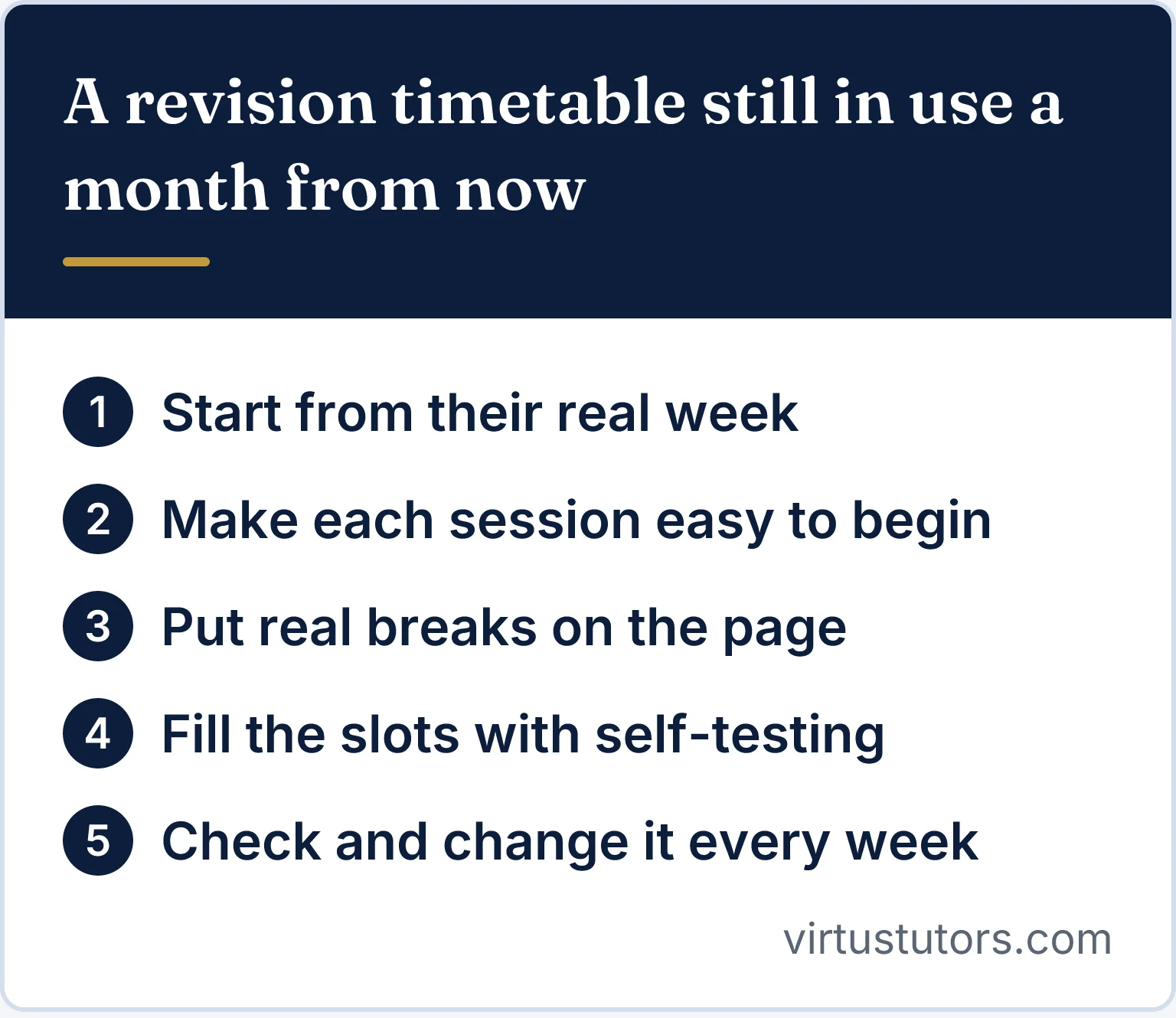
So this checklist does not aim for a perfectly balanced schedule. It aims for a timetable your teenager is still using a month from now: it starts from their real week, makes each session easy to begin, puts real breaks on the page, fills the slots with self-testing, and gets checked and changed every week.
Audit the real week before you draft anything
Most timetables fail at the drafting stage because they start from a blank grid. Before adding any revision, write down what already happens across an ordinary week: school, clubs, sport, a part-time job, meals, screen time, when your teenager seems alert and when they are finished for the day. Do this with them, not about them.
If homework already happens at the kitchen table after tea, that is the obvious place to add revision. A new slot at a time they have never worked is the slot most likely to be skipped.
Why should a parent be involved at all? The EEF's guidance on supporting revision points out that "pupils routinely engage in ineffective revision practices" when adults assume they can simply get on with it. Helping with the initial draft is reasonable. Writing the whole thing for them is where the resistance usually starts.
Front-load the low-resistance task
The hardest moment in a revision session is the start. So put the easiest or least disliked task at the beginning of each session: a quick quiz on a topic they already know, or flashcards for a subject they like. The aim is to be working before the harder material arrives, not to avoid it.
Be clear about what this rests on. None of the research cited here tests the order of tasks inside a teenager's revision session. This is practical judgement, not evidence. What the evidence does say is that students are poor judges of which habits actually work. The guest blog quoted earlier warns that re-reading and highlighting give "a false sense of security". So "easy first" should mean easy to start, such as a short self-quiz. It should not mean a passive task that feels productive and isn't.
Make breaks concrete, not aspirational
AQA's revision advice tells students to "work out your revision plan and use a planner to help you stay on track; this way you can include time for other commitments and well-deserved breaks." That is sensible, but vague. "Include breaks" is exactly the kind of instruction that disappears the moment a session goes badly, or goes well.
Put breaks on the timetable as named items with a start and an end: a walk to the shop, a snack, phone time with a timer running. The same guest blog suggests the Pomodoro technique, "using a timer to chunk down your revision sessions and to bake-in some potentially productive 'spacing'". A timer also settles the argument about when a break ends, and that argument otherwise falls to the parent.
There is good reason to prefer several shorter sessions to a single long session. An EEF blog summarising the cognitive science puts it this way: spaced practice holds that "we are more likely to remember something we revisit over time than something we study in one sitting, even if the total time spent studying is the same."
How many hours a day is realistic? The sources here do not give a figure, and we will not invent one. Even on spacing, the same EEF blog concedes "unanswered questions about application", including "the length of spaces, and whether they should remain consistent or be gradually extended." Start with what your teenager will actually do this week, then adjust.
AQA also suggests a "ransom technique": "ask your parents to keep your favourite things until you have completed agreed tasks". The tasks are agreed ones, which is less one-sided than the name makes it sound, and some families find it useful. But it still puts the parent in the enforcer's seat and turns the plan into a test of compliance, which is the situation most likely to produce "this is too rigid". A break the teenager chose is a better lever than a confiscated phone.
Fill the slots with active recall, not colour-coding
A slot labelled "chemistry" does not tell anyone what to do. What happens inside the block matters more than the block itself.
The same guest blog is direct about it: students "can be lulled into a false sense of security from re-reading or daubing their notes in a rainbow of highlighter colours." Its author recommends active strategies such as "map from memory", where the student writes out everything they can recall about a topic before checking their notes. That is retrieval practice, and it is meant to feel like hard work.
The same guest blog describes a five-stage routine taught by the author's own science team: Consolidate, Learn, Assessment, Feedback, Action. Students condense their notes, then test themselves on them. Writing that sequence into each slot turns "revise chemistry" into something a teenager can actually start and finish.
Spacing, interleaving (mixing topics within a session rather than doing each in a long block) and retrieval practice are now mainstream. An EEF-commissioned review reports that over 85% of respondents to a teacher survey called these strategies central to their teaching. The same review is honest about the limits: while they "can have a meaningful impact", evidence on how to apply them in classrooms "remains limited", and research on how they should be used "in different year groups and subject areas is lacking." They are well founded. That does not make any particular schedule proven.
Set a fixed weekly check-in
This is the step most timetables leave out. Pick a short, fixed slot each week, same day and same time, to look at the plan together. Keep it low-stakes. A few questions are enough:
- What did you actually do this week?
- What got skipped, and why?
- Which techniques seemed to work, and which just felt busy?
- What should change for next week?
In the same guest blog, its author describes their own college, where students "RAG rate their revision techniques" (red, amber, green) to track progress, and calls that "structured reflection" likely to help them "calibrate their routines". The EEF's model for teaching revision ends at the same point: supporting pupils to think about "what went well and what they would do differently next time."
There is solid evidence behind teaching young people to plan, monitor and evaluate their own learning. The EEF's Teaching and Learning Toolkit rates these "metacognition and self-regulation" approaches "high impact for very low cost", with an average of +8 months' additional progress, drawn from 355 studies and rated high security. It also warns that "it can be difficult to realise this impact in practice". That evidence comes from classroom teaching rather than from studies of home timetables, but a weekly check-in applies the same plan, monitor, evaluate cycle.
Tone matters. The check-in reviews the plan, not the teenager. If a slot keeps being skipped, the useful question is what is wrong with the slot, not what is wrong with them. Move it, shorten it or swap the task.
The honest caveat: a good plan does not guarantee results
The EEF tested a structured spaced-learning revision programme for GCSE science, called SMART Spaces, in a large trial. Pupils in the programme schools "made no additional months' progress in chemistry attainment in AQA Combined Science GCSE compared to pupils in the control schools", a result with a high security rating. This was not a badly run programme. Teachers supported it, and 70% said they would be happy to deliver it again.
The evaluation's own conclusion is that it "highlights the challenge of translating broad research findings about spaced learning into effective teaching strategies and interventions." If a well-designed programme run by teachers can fall short, a timetable drawn up at the kitchen table can too.
That is the central point of this checklist. A timetable is a hypothesis to test each week, not a formula. Judge it by whether your teenager is still using it and whether the weekly check shows them recalling more. Do not judge it by how closely it resembles an ideal schedule.
What to drop from most existing advice
Drop the idea that planning happens once. AQA's advice to "work out your revision plan" and use a planner to stay on track is sound as far as it goes. What it does not add is the habit of going back to the plan. Build the weekly review in from the start.
Drop compliance devices as the main lever. The "ransom technique" puts the parent in charge of enforcement. Negotiated breaks and a weekly review ask less of the relationship.
Drop the beautiful grid as the goal. The guest blog quoted earlier warns that colour-coded plans can stand in for the hard thinking of revision. A scruffy plan that gets used beats a beautiful plan that doesn't.
Drop passive revision from the slots. Re-reading and highlighting feel safe and give a false sense of security. Replace them with self-testing.
Can you do this yourself?
Usually, yes. The method needs no special expertise: start from the real week, make starting easy, schedule breaks, fill the slots with self-testing, and review weekly. The harder part tends to be inside the slots: knowing which topics to test and what a good answer looks like. For self-testing material, Virtus Academy is a free GCSE resources site run by the same owner, publishing revision worksheets that fit straight into a retrieval slot.
If the slots are the hard part
Virtus Tutors teaches GCSE Maths, GCSE Science and GCSE English one to one, online, to students in the UK and internationally. Lessons are from £25 per hour (GBP). The starting point is a free 15-minute assessment call, and we reply to every enquiry within 24 hours.
Sources
Linking to primary sources is part of why this article is worth linking to.
- AQA: Revision support for students and parents
- EEF guest blog: Building study habits and revision routines
- EEF: Supporting revision and the seven-step model
- EEF blog: The ABC of cognitive science
- EEF Teaching and Learning Toolkit: Metacognition and self-regulation
- EEF: SMART Spaces project and evaluation
- EEF: What do we really know about cognitive science in the classroom? (review of the evidence)