
Are GCSE mocks accurate? What a mock grade really tells you
Are GCSE mocks accurate? A mock grade is a useful reading of what your child knows now. It is a snapshot rather than a forecast, and the evidence suggests treating it with some caution before you act on either a low or a high result.
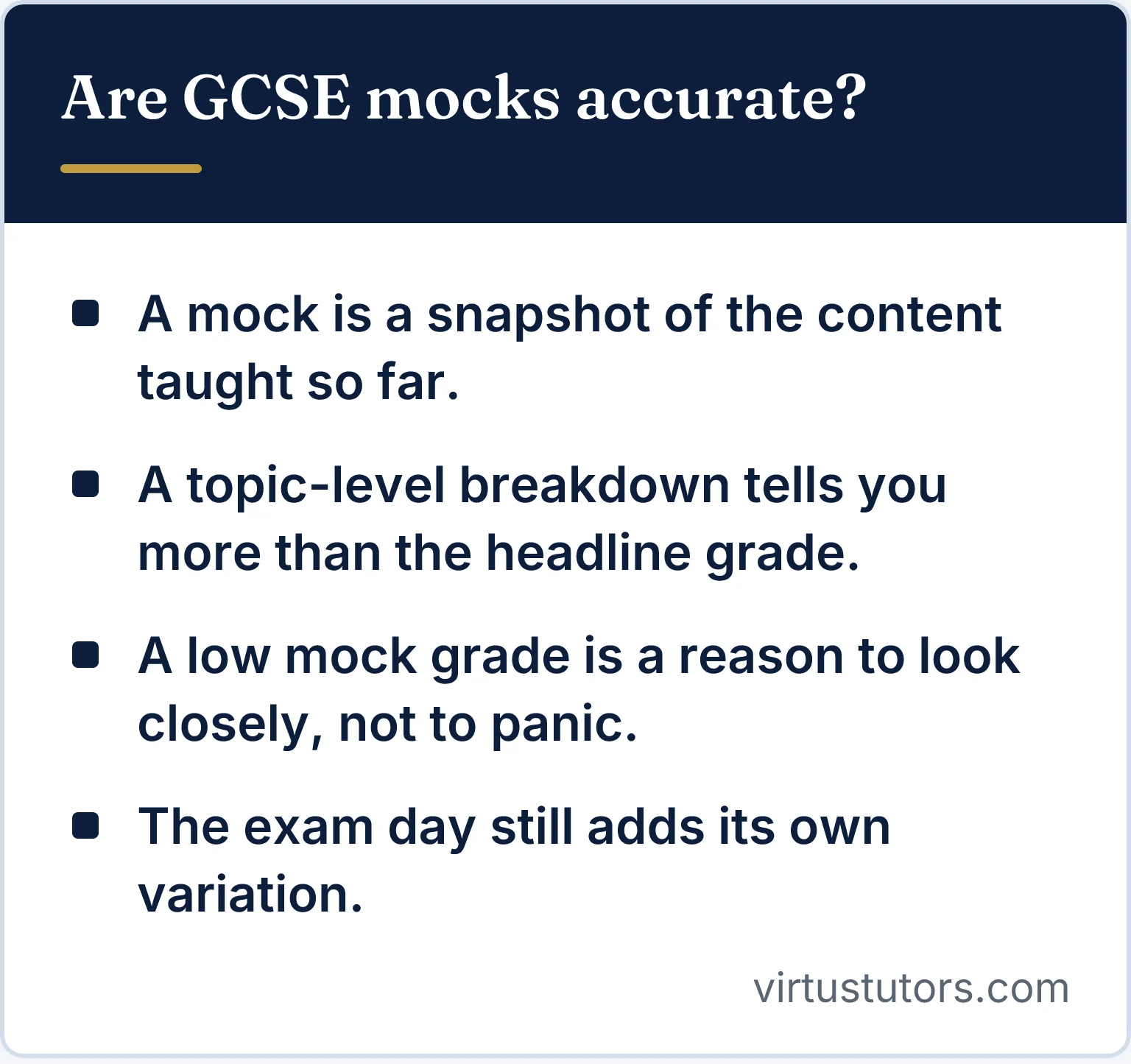
The myth and the fact
The myth is that a mock grade is a forecast: whatever is on the report is roughly what will be on the results slip. The fact is that a mock is a snapshot of the content taught so far, not a forecast. Ofqual draws the distinction itself. In 2020, when exams were cancelled, it asked teachers "to judge the grade a student would have achieved if they had sat their exams". In 2021 it asked them to judge "students’ performance on the content they have been taught". Those are different questions, and a mock answers neither perfectly.
A mock was also only one kind of evidence. When schools used mocks as evidence in place of cancelled exams, Ofqual says the evidence included "mock exam results, marks from work completed throughout the course, and predicted and target grades".
Why grades given without an exam tend to run generous
Ofqual's research into 2020 found that teachers "tended to give their students the grade they thought they could achieve if they had “a good day” in the exams". Whether mock grades share that tilt has not been measured, but it is worth bearing in mind if a mock grade looks higher than recent classwork suggests.
The national evidence points the same way. An evaluation of summer 2020, when centre-assessed grades replaced exams, found grades "were on average around half a grade higher than grades from previous years for both GCSE and A levels". The same evaluation notes that previous studies "have indicated that teacher grades tend to be more generous than those achieved by candidates in exams".
The picture is not entirely simple. A review of the research reports "ample evidence of teachers’ tendency towards generosity in grade prediction", but little evidence of teachers over-rating students relative to test results in National Curriculum assessment in England. Studies from abroad did find over-rating much more common than under-rating. So the generosity is well documented for predictions; for day-to-day assessment it is less clear-cut.
How closely do teacher judgements match test results?
How often do teacher judgements and test results agree exactly? The review reports that "Over 60% absolute agreement was found in all subjects at KS2 and KS3, except for KS3 English", while every curriculum area at KS1, and KS3 English, came in under 60%. Absolute agreement means both give the same result. At best, that is a majority, not near-certainty.
Measured more loosely, by whether teachers and tests put students in the same rank order, the review reports correlations of 0.74 for English and maths at KS1 and a range of 0.64 to 0.78 at KS2 and KS3. KS3 science fell to 0.25, which the researchers put down largely to the low reliability of the test itself.
One more comparison from the review is worth knowing. It reports that the agreement in rank order between teacher and test-based assessment "is of a comparable level to the relative agreement between teacher prediction and actual achievement". In other words, on this measure, teachers' judgements of current attainment line up with test results about as closely as their predictions line up with final results. The review is about teacher assessment in general, not mocks specifically.
A caveat on this evidence. These studies compare teacher assessment with National Curriculum tests at KS1, KS2 and KS3, not GCSE mocks with GCSE results. There is no published figure here for how often a mock grade matches the summer grade, and it would be wrong to invent one. They are the closest evidence available, and they point the same way.
What a mock can tell you
None of this makes a mock useless. The same evaluation of centre-assessed grades found: "The strongest predictor by far of grade outcomes was a candidate’s prior attainment for both GCSE and A level." A student's track record carries real information. A mock adds to that track record: it is a genuine reading of what has been learned and what has not.
What a mock cannot tell you: the exam day
What a mock cannot capture is the exam day itself. The same evaluation suggests the stronger link with prior attainment that year may reflect grades "factoring out ‘unpredictable’ variation in student outcomes, seen in normal years due to factors such as exam anxiety, last minute revision or the combination of questions which come up on exam papers". A real exam adds its own variation, and no mock can fully rehearse it.
Ofqual has language for this. It defines assessment error as the difference between the result a student "ought to have been awarded" and the result they ended up with, and separates random error, "known as unreliability", from systematic error, "known as bias". Its example of random error is "the luck of the draw that means you end up having to answer an exam question on a topic you forgot to revise".
What this means if your child has just sat mocks
- Read the grade as a snapshot of the content taught so far, not a forecast.
- Ask for the topic-level breakdown. Which questions were dropped, and why, tells you more than the headline grade.
- If the grade sits near a boundary, treat it as close to a coin-flip. A teacher interviewed by Ofqual put it this way: in an exam "roughly half of them will get the higher grade, half will get the lower".
- Look at the trend in prior attainment, not the latest result alone.
- Use the mock to start a conversation about revision, not to deliver a verdict.
So a low mock grade is a reason to look closely at which topics went wrong, not automatically a reason to panic. A high mock grade is good news about what your child knows now, but it is not a guarantee: the exam day still adds its own variation. Either way, the useful question is the same: what does the breakdown show, and what is the plan between now and the summer exams?
Want a second opinion on a mock result?
Virtus Tutors teaches GCSE Maths, GCSE Science and GCSE English one to one, online, to students in the UK and internationally. Lessons are from £25 per hour (GBP). A free 15-minute assessment call can look at what the mock breakdown shows, and we reply within 24 hours.
Sources
Linking to primary sources is part of why this article is worth linking to.