Combined science or triple science: it is not about ambition
The usual advice on combined science or triple science is short: triple for the clever, combined for everyone else. Ofqual's and the exam boards' own descriptions point somewhere else. Combined science is not an easier version of the same thing. It is a differently shaped qualification, and the right choice depends on how a student copes with breadth and workload as much as on a predicted grade.
The difference is shape, not difficulty
There are two routes. Combined science is one qualification, an award worth 2 GCSEs, covering biology, chemistry and physics. The separate sciences, usually called triple science, are single GCSEs in biology, chemistry and physics, each with its own grade.
Ofqual's explanation of science grading says combined science students "will study all three sciences and they’ll cover roughly two thirds of the content of the single GCSEs in biology, chemistry and physics." It adds that "the overall exam time is similar to that for two GCSEs".
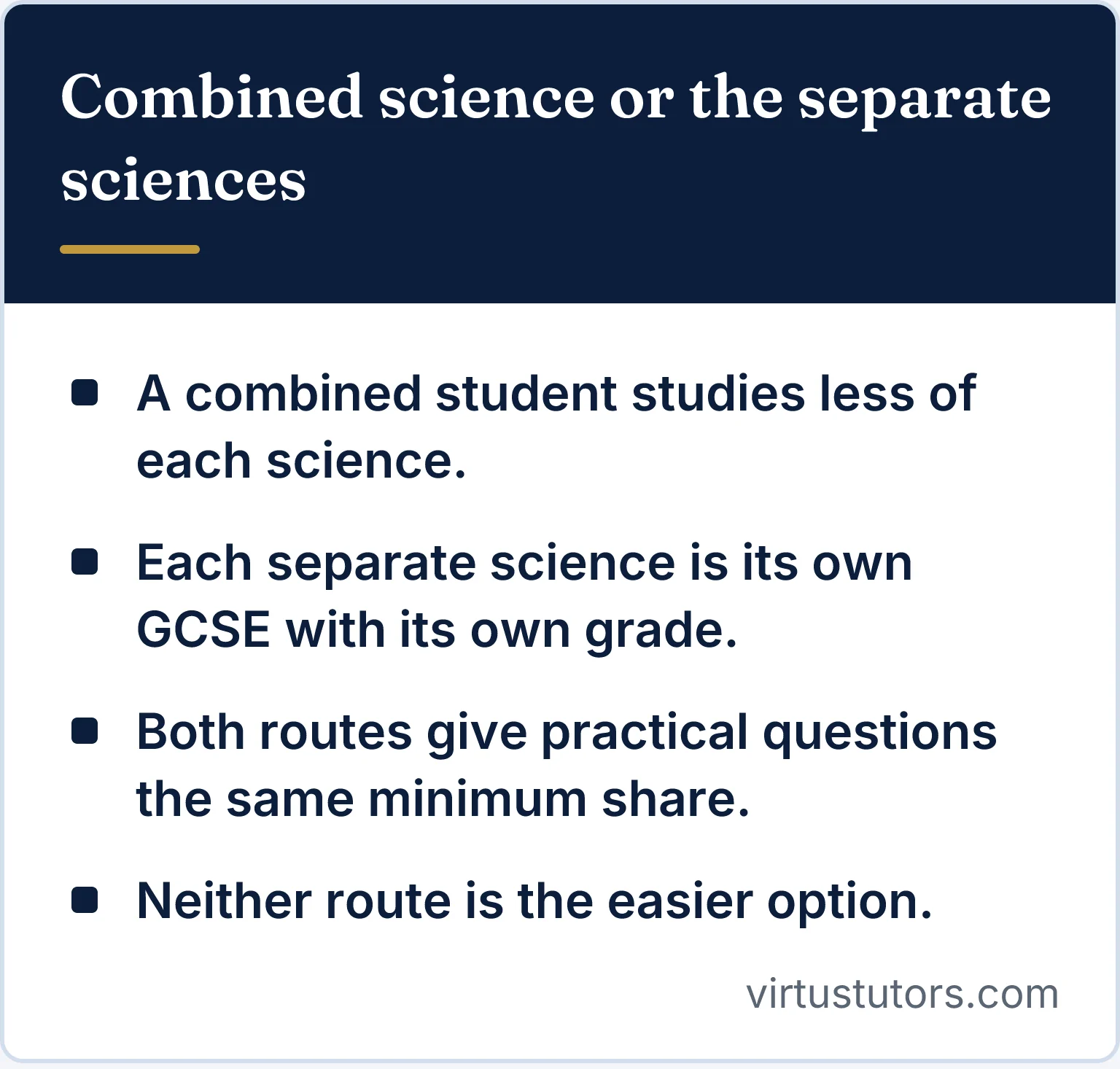
That is a reduction in quantity, not in difficulty. A combined student studies less of each science, but the content they do study is the content of the single GCSEs, at the same standard. Advice that treats “less” and “easier” as the same thing misreads it.
What each route asks a student to sit
AQA's combined science specification (Trilogy) sets out the exam structure: "There are six papers: two biology, two chemistry and two physics. Each of the papers will assess knowledge and understanding from distinct topic areas." Other exam boards offer combined science too, so check which board your child's school uses.
The separate sciences are three full GCSEs, each with its own grade. The exam board’s specification gives the number and length of the papers for each route, so check the one your child’s school uses.
Both routes cover biology, chemistry and physics, so both involve switching between sciences. The trade-off in workload is depth against volume. A combined student holds all three sciences in a qualification worth two GCSEs. A student taking the separate sciences goes further into each subject and carries the content of three full GCSEs.
How combined science is graded
Combined science leads to an award worth 2 GCSEs, given as a double grade. Ofqual explains: "The double grade will be based on their overall mark across the three subjects; they won’t get a separate mark for each science, and good performance in one area will compensate for weaker performance in another, as in any GCSE."
In practice, a weak physics paper does not sink a combined grade by itself. The separate sciences work differently. Each is its own GCSE with its own grade, so a weak physics result shows up in the physics grade alone. The compensation cuts both ways: a combined student cannot keep a strong biology grade apart from a weak physics result either.
Practical work: different lists, same weight in the exam
AQA sets a list of required practicals for each route: 21 for combined science, and ten for GCSE Biology by itself. Both lists come with the same caveat: they are "not designed to limit the practical activities carried out by students". A student taking the separate sciences also has required practicals for chemistry and physics on top of biology, set out in each subject’s specification.
What matters more for the exam is weight. In both AQA specifications, questions in the written exams "will draw on the knowledge and understanding students have gained by carrying out the practical activities", and those questions count for the same minimum share of the overall marks.
So combined science is not the practical-light option it is sometimes taken for. The listed practicals differ between the routes, but both routes give practical-based questions the same minimum share of the marks.
Who takes which
Combined science is by far the most common route. Official provisional entry statistics for the summer 2026 exam series in England show 951,510 combined science entries, against 169,915 for biology, 161,400 for chemistry and 161,305 for physics. The combined figure is double counted, “because combined science is the equivalent of 2 GCSE grades”. Halved to count students rather than grades, it is 475,755.
These figures have limits. They do not show which students chose which route, or why, or how prior attainment and predicted grades differ between the two groups. They cannot prove that able students choose combined science. They do show that taking it puts a student in the much larger group, not in a remedial one.
What this means for a capable, breadth-averse student
A predicted grade is a fair starting point, but it answers only part of the question, and a mock grade tells you less than it seems. Sixth-form requirements vary, so if your child is considering A-level sciences, check with the sixth form they are aiming for before deciding.
Workload. Triple science means the full content of three GCSEs. Combined covers roughly two thirds of that, in exam time Ofqual describes as similar to two GCSEs. For a student already stretched across other subjects, that difference is real, and so is the value of a revision timetable they will actually follow.
Breadth. Both routes cover all three sciences. Combined science spreads them across six papers, each on distinct topic areas, so a student still switches between subjects. The question is whether your child copes better with more depth in each science or less of each.
A weaker subject. In combined science, good performance in one area compensates for weaker performance in another. In the separate sciences, a weak subject produces its own grade. Neither is safer in general; it depends on how uneven your child's sciences are.
The choice itself. Neither route is the easier option. If your child prefers combined science for reasons of breadth or workload, that is a reasonable choice, not a lack of ambition. Check any sixth-form requirements before deciding.
The usual framing asks only how clever a child is. A better question is what shape of qualification suits them: deeper and longer, or broader and more compressed. Both are real science GCSEs, and both deserve to be chosen on purpose.
Support with GCSE Science, whichever route
Virtus Tutors teaches GCSE Maths, GCSE Science and GCSE English one to one, online, to students in the UK and internationally. Lessons are from £25 per hour (GBP). We start with a free 15-minute assessment call, and we reply to enquiries within 24 hours.
Sources
Linking to primary sources is part of why this article is worth linking to.