
Sleep and stress in GCSE exams: what a parent can control
Sleep and stress in GCSE exams are linked, but a parent cannot control either directly. What you can influence is narrower and more useful: the shape of the evenings, how you read the signs of strain, and what happens on the night before a paper.
This matters most in the run-up to the summer exam series, and in the weeks before school mocks, which each school sets itself. Pressure builds slowly over that stretch. By the time a teenager is visibly struggling, it may have been building for a while.
Three levers, not one
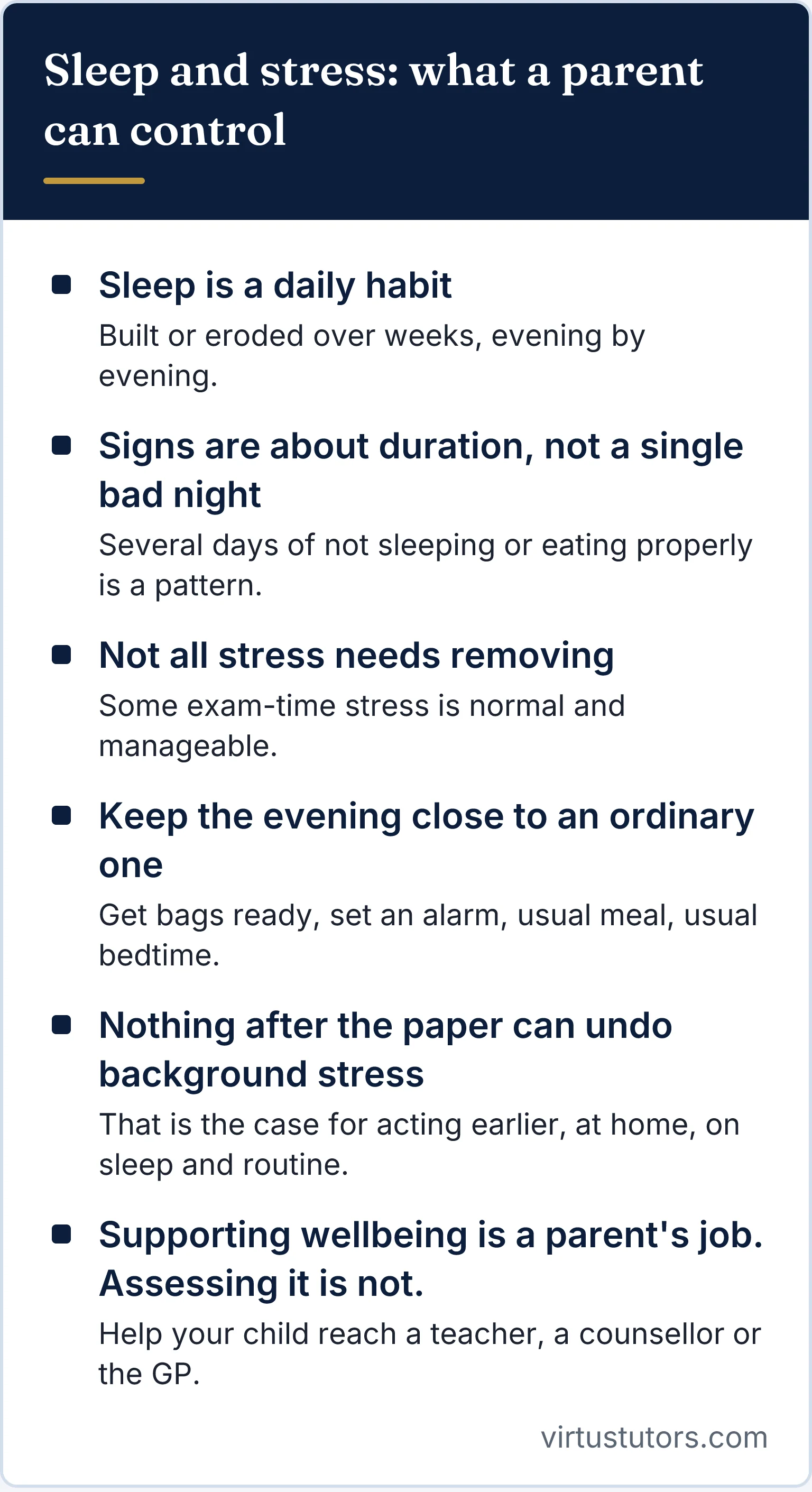
Sleep is a daily habit. It is built or eroded over weeks, evening by evening, and it is the lever you see most clearly.
Background anxiety is a slow burn. It is a mood that builds under the surface, and you influence it indirectly: through routine, through how home feels, and through knowing when to involve someone else.
The night before is a short window. It is narrow, but it is the evening where a few practical choices make the next morning calmer.
Does lost sleep actually hurt results?
The honest answer is that nobody can tell you how many marks a short night costs your child. What the evidence supports is narrower. A guest post on Ofqual's blog cites research (Putwain and Daly) suggesting that around 15% of GCSE students may be ‘highly test anxious’, and that for these students stress and anxiety are "high enough that their well being and exam performance can be negatively affected".
Sleep sits inside that picture rather than apart from it. A separate guest post on Ofqual's blog relays a model proposed by Gareth Hughes, a Human Givens psychotherapist working in psychological wellbeing at the University of Derby, which treats academic performance as resting on physical, psychological and social needs being met in balance. The physical strand is "Physical health, including sleep, nutrition and exercise". That is a practitioner's framework, hosted on Ofqual's blog, not Ofqual's own position. It is useful because it is plain: sleep is a part of a balance, not a cure on its own.
When sleep and stress matter more
Childline, writing a guest post on the Department for Education's Education Hub blog, says that of all the counselling sessions it has provided on managing exam stress, 22% are delivered in May. The children it hears from report struggling to balance revision with breaks, "suffering from a lack of sleep and sometimes even having nightmares".
May falls inside the summer exam series, so that peak is no surprise. The weeks before mocks are a smaller version of the same squeeze, and a useful rehearsal: how your child sleeps and copes then tells you something about the summer. What a mock grade itself does and does not tell you is a separate question.
Ordinary nerves, or something more?
Two exam boards start from the same place. AQA tells students that exam season "can be a stressful and overwhelming time, and it’s completely normal to feel anxious". OCR draws the line more sharply: "some levels of stress at exam time are normal and manageable", but "that’s not the same as feeling overwhelmed by anxiety".
The signs worth noticing are about duration, not a single bad night. OCR lists "You can’t sleep" among the symptoms for which it tells students to "seek help". AQA's warning signs include "not sleeping or eating properly for several days". A restless night before a paper is ordinary. Several days of not sleeping or eating properly is a pattern, and it is the point to stop managing it alone at home.
Is a bit of stress useful?
Not all stress needs removing. OCR calls some exam-time stress "normal and manageable", and the aim is to keep it there rather than to make your child feel nothing. The guest post that relays the Hughes model also summarises research on what helps. Relaxation techniques "can help alleviate the physiological aspects of test anxiety, such as increased heart rate or feelings of nausea". Skill-building interventions "result in increased task and examination performance and may result in associated decreases in test anxiety".
The skill-building finding is the more useful for a parent. Being better prepared may itself lower anxiety, which is a reason a revision timetable built around real breaks is worth the effort. The post was written about what schools can do, not about home, so treat it as a direction rather than a recipe.
The night before: what to do, and what to leave
- Get bags, pens, calculator and anything else the paper needs ready in the evening, so the morning has fewer decisions in it.
- Set an alarm, and agree when the household will be up.
- Keep the evening close to an ordinary one: usual meal, usual bedtime.
- Leave the content alone. This is not the evening to start an argument about how much revision has been done.
- If your child wants company, offer it. If they want quiet, give them that instead.
None of this is clever. Its value is that it is within your control, unlike the paper itself.
Why the exam system won't fix background stress
It is natural to hope that if stress spoils a paper, allowances will be made. The system does adjust, but for narrower situations than many parents expect. JCQ's guidance on special consideration says centres must only apply where "an adverse issue or event has had, or is reasonably likely to have had, a material effect" on a candidate's ability to take an assessment or show their normal level of attainment. Even then, it says special consideration "can only go some way" to help and "cannot remove the difficulty faced by the candidate".
Separate invigilation is for a candidate with "a substantial and long-term impairment", such as "long-term social, emotional and mental health needs". JCQ adds that the difficulties "must be well established" and known to staff such as the form tutor and head of year. It also notes that requests for separate invigilation due to exam anxiety are increasing.
Read together, these rules point the same way. The system is built to respond to events that affect a specific assessment and to needs that are long-term and well established. Ordinary background stress that has crept up over a revision term is unlikely to fit either, and nothing after the paper can undo it. That is the case for acting earlier, at home, on sleep and routine. If you think your child's situation might qualify, ask the school.
Where your role stops
Supporting wellbeing is a parent's job. Assessing it is not. OCR's advice to students who notice signs like being unable to sleep is: "Talk to your family, a teacher who knows you well, a counsellor at your school or your GP." Family is in that list, but it is not the only stop. If what you are seeing has lasted several days, or is getting worse, your part is to help your child reach a teacher, a counsellor or the GP.
Within your role, Childline's guest post suggests helping children "think of healthy ways to cope", with things like yoga, breathing exercises or mindfulness done together. A student guide published on gov.uk, Coping with exam pressure, was developed with Professor Dave Putwain, a researcher at Liverpool John Moores University, and offers "practical strategies" for GCSE students experiencing exam-related stress. It is written for your child to read, which may be the point: it gives them something to use without you standing over them.
So, are you overreacting? Probably not, if you are noticing a pattern rather than a night. Lost sleep matters as part of a wider balance, and a parent's levers are real but modest: a steady evening routine, a calm night before each paper, a watchful eye on how long any change lasts, and knowing when to hand over to the school or GP.
Worried that revision is not translating into results?
Virtus Tutors teaches GCSE Maths, GCSE Science and GCSE English one to one, online, to students in the UK and internationally. Lessons are from £25 per hour (GBP). Start with a free 15-minute assessment call, and we reply to every enquiry within 24 hours.
Sources
Linking to primary sources is part of why this article is worth linking to.
- OCR: Managing stress
- AQA: Managing stress
- Ofqual blog (guest post): What is it like to experience exam stress? A student perspective
- Ofqual blog (guest post): What can schools do about examination and test anxiety?
- DfE Education Hub (Childline guest post): How to cope with exam stress
- gov.uk: Coping with exam pressure, a guide for students
- JCQ: Understanding the requirements for separate invigilation
- JCQ: A guide to the special consideration process